Superpresence - Freelancer vs. Agency vs. In-House vs. AI: Who Should Build Your Website?
You have four options for building a website:
● Freelancer
● Web design agency
● In-house developer
● AI website builder
None of them is right for everyone. The best fit depends on your budget, your workload, and the risk you can carry. And the cheapest quote is only a bargain if the risk behind it is one you can afford.
Here’s how each option compare:
Option | Cost | Control | Speed | Main Risk |
Freelancer | Low | Medium | Fast | One person's availability |
Agency | High | Medium | Medium | Paying for coordination you might not get |
In-house | Highest (ongoing) | High | Fast | Paying for a salary with no guaranteed workload |
AI | Lowest | Low | Fastest | Nobody checking and testing the strategy or the forms that could mean your sales |
Please note: Data is based on our experience building sites for B2B and B2C companies and not formal benchmarks.
Let’s get you into the details of each.
1. Freelancer: The most affordable way to hire a professional
Next to AI builders, hiring a freelancer is the most affordable option to build a business site with an expert. You deal directly with the person doing the work. No account managers. No phone tag. You'll get personal service at a fair price.
Hiring a freelance website builder works well for small teams of two to five wanting a solid site at a more affordable cost.
However, since one person means one calendar, if your hired freelancer gets sick or lands a bigger client, you’ll get no backup.
This risk is costly if your website is your main channel for attracting leads. You can’t afford your digital storefront to be sitting idle for weeks just because your freelance builder goes quiet mid-build.
Tip: Make sure to get the scope in clear writing before hiring.
2. Agency: A managed team for complex projects and ongoing support
Unlike freelancers, paying for a web design agency excuses you from the risk of a single point of failure and ensures complete project ownership. With an agency, you’re paying for a coordinated team, not just one person’s hours. Which is why agencies price higher than freelancers.
If your goal in building a site is to attract and manage leads, not just serve a one-off purpose, you need architecture that connects lead capture, CRM integration, custom features, and testing. An agency brings the team to build it: designers, copywriters, developers, QA engineers, and project managers.
However, not every agency delivers what you're paying for. You might ask why a page was built a certain way and get passed to a developer you've never met. Worse, some agencies quietly outsource to freelancers while pocketing the difference.
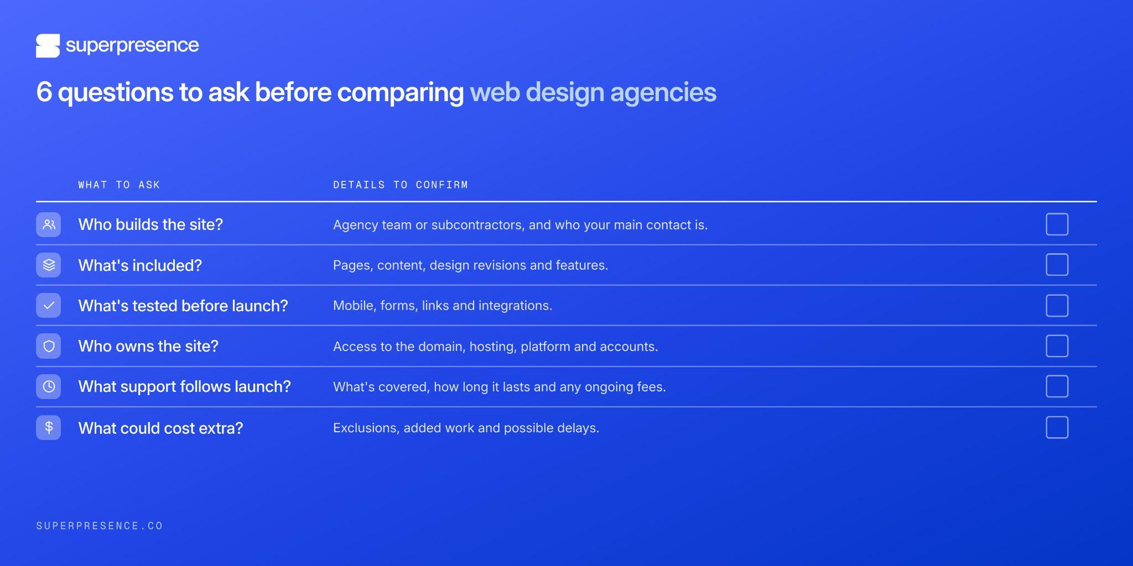
So before comparing quotes, make sure to know what's included and who does what.
3. In-house: The right fit when website work is constant
An in-house developer goes one step further than an agency: instead of renting a team, you own the capacity. The upside is complete control. Your priorities set the schedule. No quotes, no briefs, and no waiting in someone else's queue.
That control has a serious price. In Australia, Glassdoor data (September 2026, 900 salaries) puts pay for web developers with 1 to 3 years of experience at $60,000–$83,000 a year, about $70,000 on average — before super and tools.
A salary that size only pays for itself when the work is constant: new content, analytics, experiments, integrations. It's why in-house developers are common among established B2B companies.
Yet, the trap is timing. Once your site launches and the work drops to occasional tweaks, you're still paying a full salary.
So match the hire to the workload. If you're a founder building your first website, you likely need a defined project, not a permanent role. Getting a freelancer or an agency are your good options.
4. AI: A fast way to build a simple site, with strategy still needed
Lastly, the disruptor among four— AI site builders.
Today, AI can get you a working website in hours. Wix’s Harmony (released January 2026), for instance, turns one prompt with your business concept, purpose, and audience into a functional draft in minutes, complete with copy, images, SEO setup, and booking forms. Its AI agent, Aria, then handles further changes via chat.
Conversely, AI can't replace human thinking. If you ask it to write a headline, it'll give you the same generic lines your competitors use. It can also build contact forms that look fine — but it doesn't know where to place them to get more enquiries. So, AI can build, but it can't strategise.
While AI is for speed, humans are for strategy. That synergy is what Superpresence builds on. So we use AI for assisted website production, but only on Webflow. Webflow can handle complex projects better than Wix or drag-and-drop builders. And on every project, we stay accountable for positioning and testing.
Choose the builder that fits your needs now—and can grow with your business
The right website builder depends on how you envision your business growing.
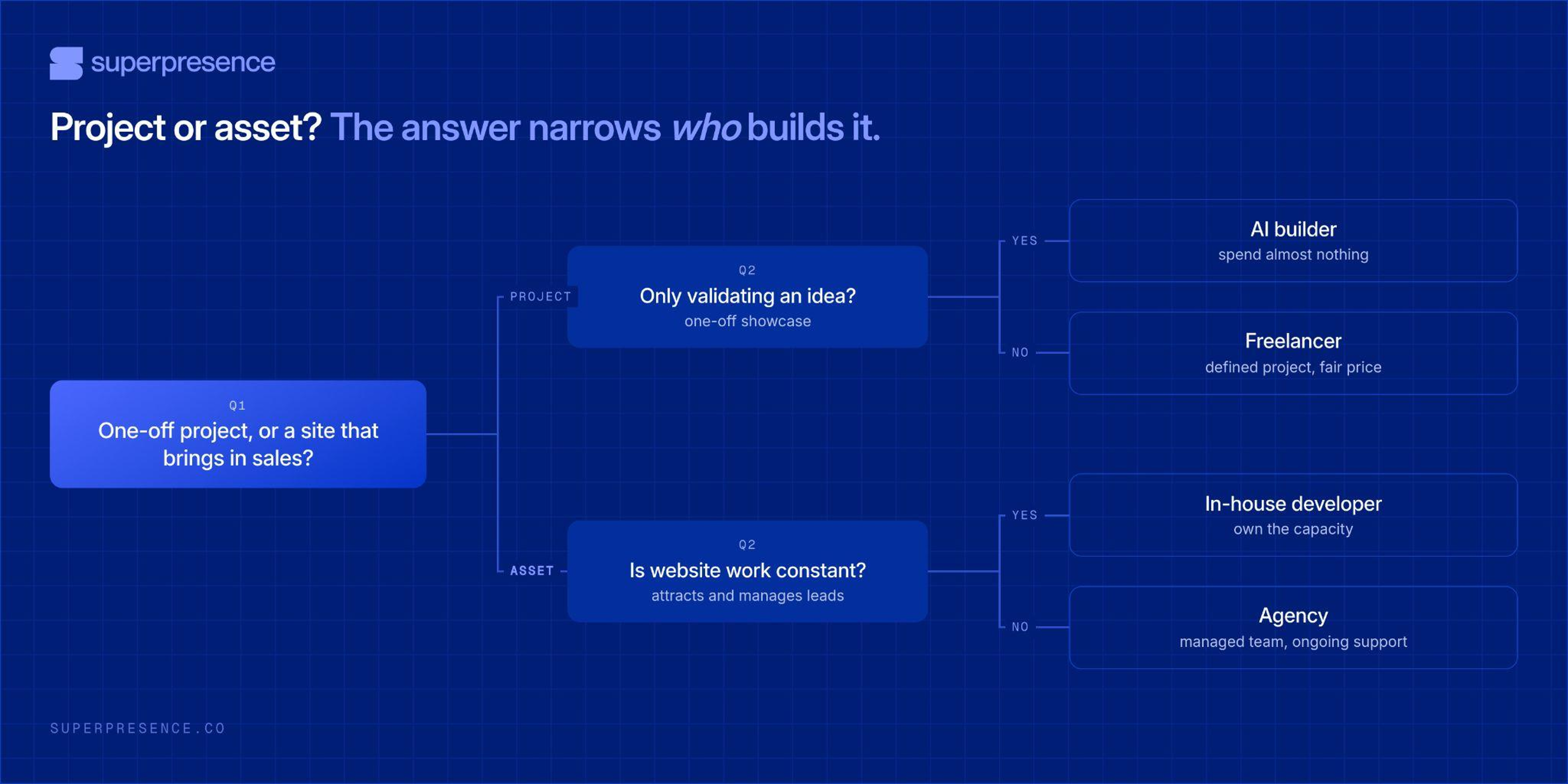
Three questions settle your search:
1. Project or asset: Are you building a one-off showcase, or the site that represents your business and brings in sales?
2. Accountability: If you go with a freelancer or AI builder, who maintains the site after launch? If the answer is "no one," factor that in now.
3. Risk: What happens if your site is built wrong and not just slow? Count lost leads and credibility. Is your site architected to rank on Google or AI search? Price that in before you close deals.
Most business owners arrive with a fair idea of what they want to build. If that's you, trust your instincts. Just get a second opinion before you commit the budget.
Our web design services include a free website audit. Our experts review your site and give you a straight verdict: whether a freelancer will do, whether an AI builder is enough, or whether the job needs a custom build. If the cheaper option works, we'll say so.
Superpresence helps businesses based in Australia and Thailand sell to English-speaking and foreign buyers. We look at how overseas customers find you, judge you, and buy from you, then tell you what to fix first. The advice is obligation-free, and it's what we'd do if it were our business.
Follow us on LinkedIn and Instagram.
Email me at kelvin@superpresence.co.