JLL Projects Resilient Growth and Fresh Momentum for Thailand Real Estate in 2027
Foreign inflows, private wealth, and prime hotel demand power positive momentum across Thailand, while for office buildings, high-quality space, flexible ready-fitted solutions, and hospitality-style operations emerge as the winning formula for 2027.
Bangkok, November 18, 2026 — Thailand’s real estate market will move into 2027 in a more selective phase, with capital concentrating on assets backed by sound macroeconomic fundamentals and genuine occupier and visitor demand, according to JLL Thailand. Foreign investment and demand are expected to be the main drivers of growth, with opportunities emerging across key property sectors and growth corridors beyond Bangkok. These insights form part of JLL Thailand’s 2027 real estate outlook, drawing on the firm’s market research, transaction activity and property management expertise.
JLL Thailand closing 2026 with strong momentum across its business, supported by steady activity in property sales, corporate leasing, and estate operations. In Capital Markets and Hotels, the team advised both buyers and sellers—ranging from global institutional investors to high-net-worth families and private owners—on major property acquisitions, strategic sales, long-term leaseholds, and land transactions for growing sectors like data centre, Industrial & Logistics assets and hotels. In Office Leasing, JLL guided multinational corporations and international organisations through major relocations as businesses continued upgrading to better-quality spaces. On the operational side, JLL solidified its market-leading position in Property Management by expanding its footprint across landmark mixed-use districts, prime office towers, and large coastal resort destinations, while the Project & Development Services team completed several of Bangkok's largest corporate workplace fit-outs and advised high-spec industrial and digital infrastructure projects.
By supporting clients across the entire property lifecycle from initial investment and project delivery to leasing and daily building operations, JLL has a front row view of how market priorities are shifting ahead of 2027.
Growth is spreading beyond Bangkok
JLL’s research points to a market that is becoming steadily less Bangkok-centric. Its Planning for a Multipolar World analysis identifies the Eastern Economic Corridor (EEC) as the anchor of Thailand’s next growth phase, with development extending to tourism destinations such as Phuket and Phang Nga, where wellness-led hospitality, retail and ultra-luxury residential are expected to play a larger role. Alongside institutional capital, private wealth is increasingly shaping the market. Amid ongoing global economic and geopolitical uncertainty, high-net-worth individuals and family offices are treating prime real estate as a dependable safe haven. This has spurred targeted demand for irreplaceable plots of land—both in prime Bangkok locations and high-end resort markets—where buyers are prioritising long-term wealth preservation and strong capital appreciation.
Industrial demand is moving up the value chain at the same time. China+1 supply-chain diversification is directing new manufacturing investment towards electronics, electric vehicles, advanced logistics and specialised production, and developers are shifting towards assets that generate recurring income. Foreign direct investment applications to the Board of Investment (BOI) rose 62% year-on-year to THB 1.55 trillion in the first nine months of 2026, led by digital infrastructure and electronics. Cumulative BOI approvals across the EV supply chain reached THB 151.4 billion by end-August, with battery manufacturing the largest segment.
“Thailand goes into 2027 as a selective market, and that selectivity is healthy. Capital is still arriving, but it is following macro fundamentals and real end-user demand, whether that means a manufacturer committing to a facility in the Eastern Economic Corridor or a hotel buyer underwriting tourism growth in key resort destinations. Foreign investment and foreign demand will be the main drivers of growth next year while Thai private wealth investors are becoming more active. The assets that attract that capital will be the ones that can show clear growth opportunities and why it will last,” said Krit Pimhataivoot, Country Head & Head of Capital Markets, JLL Thailand.
Hotels: fewer buyers, firmer conviction
Thailand’s hotel investment market comes off a record 2025, when transaction volume reached THB 27.6 billion, close to double the 10-year average (2016-2025) of THB 13.9 billion, according to JLL Hotels & Hospitality Group. Average daily rates have risen above pre-pandemic levels as younger travellers who prioritise experiences drive growth in the lifestyle and experiential luxury segments. Hotel assets with Board of Investment (BOI) promotion remain highly sought after.
“The hotel market has split. Well-located assets in prime location with strong distribution system show good performance, and the gap with weaker hotels keeps widening. The buyer pool is smaller than it was, yet the cash-rich and high-conviction investors remain active, partly because bank financing has become harder to secure. That also explains why leasehold deals are gaining ground. For a developer who does not need to underwrite an exit, a long lease can be the more efficient route into a strong location,” said Pimpanga Yomchinda, Executive Vice President, Investment Sales, JLL Hotels & Hospitality Group, Asia Pacific
Offices: Flight-to-Quality is still a trend, but adds flight-to-efficiency
Nearly 380,000 sqm of occupier demand relocated to prime office buildings in Bangkok between 2021 and 2025, three times the pre-pandemic level, according to JLL’s latest Bangkok Office Whitepaper. That movement continues against a backdrop of heavy new supply. Prime CBD vacancy reached 31.8% in the first quarter of 2026, above 30% for the first time since 2000, while prime gross rents rose 1.1% quarter-on-quarter to THB 1,023 per sqm per month. The outcome is a two-speed market in which older buildings face mounting pressure to reposition. Many are now undergoing major refurbishment that goes beyond aesthetics to include the amenities tenants now expect.
“While flight-to-quality remains a defining trend, 2026 is seeing another rising trend in flight-to-efficiency compared with 2024–2025, as there are group of tenants who grab opportunities to be in well-located, older Grade A buildings offering great value, particularly those with furnished space.
Flexibility has become a top priority: while some corporates are delaying decisions until there is more clarity, some chose to move ahead with the space with favoring fit-outs that are easy to adapt. This is supported by a growing supply of fully-furnished space, both newly fitted by landlords and nicely finished units vacated by outgoing tenants, allowing incoming tenants to keep the upfront capital low and can move in quickly,” said Thananun Ruengveeravich, Head of Leasing, JLL Thailand.
Operations as a driver of asset value
Rising ESG standards are widening the gap between future-ready and ageing buildings. In Bangkok, older energy-inefficient offices and retail buildings face a growing valuation discount, which in turn is creating opportunities for retrofits, conversions and repositioning. For owners, operating efficiency, technology, resilience and tenant experience now bear directly on how competitive an asset is and what it is worth.
“Building owners will be judged in 2027 on how their assets perform day to day as much as on where they are. Tenants now expect a hospitality-style experience from the buildings they work in, and that is where our property management team is putting a growing share of its effort. Climate resilience has also become a commercial issue. Flood risk and the wider effects of climate change now feed into leasing decisions and investment underwriting, and owners who invest in operations, technology and resilience ahead of that shift will hold on to both their tenants and their value,” said Chakrapan Pawangkarat, Head of Property Management, JLL Thailand.
For more information about JLL Thailand, visit jll.com
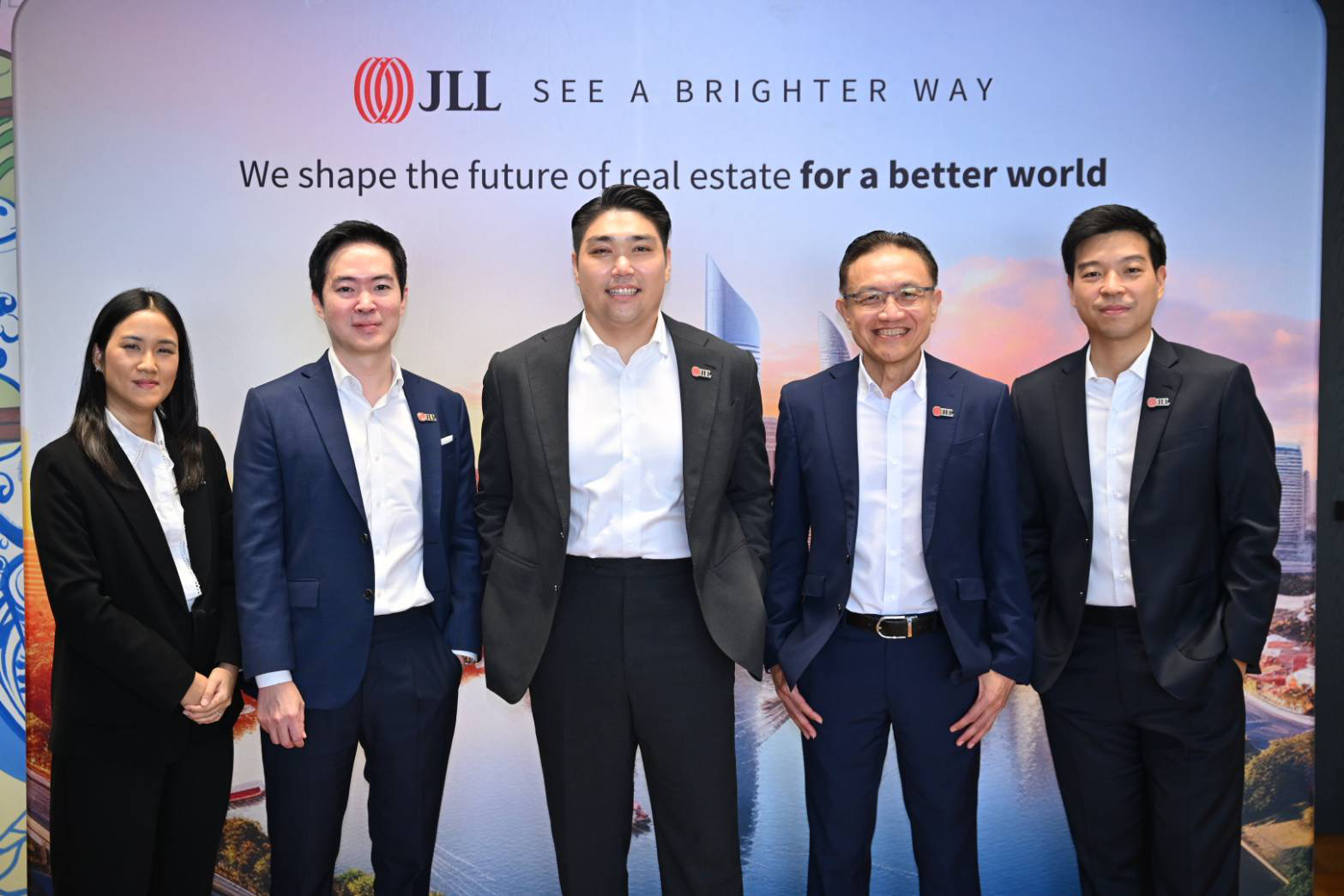
From left: Pimpanga Yomchinda, Executive Vice President, Investment Sales, JLL Hotels & Hospitality Group, Asia Pacific; Thananun Ruengveeravich, Head of Leasing; Krit Pimhataivoot, Country Head & Head of Capital Markets; Chakrapan Pawangkarat, Head of Property Management; Anawin Chiamprasert, Head of Research & Consultancy