ASW CONSULTING - AI and the Future of Work: How Job Seekers in Southeast Asia Can Stay Ahead
As artificial intelligence (AI) dynamically transforms the way we work, Southeast Asia (SEA) is right at the centre of this shift. According to Gallagher’s 2026 AI Adoption and Risk Survey, 63% of businesses worldwide have already adopted AI technologies, mainly to address skills shortages and improve productivity.
At the same time, AI is delivering strong business outcomes. The survey also found that 82% of organisations reported positive impacts from AI adoption, including improved efficiency and decision-making. However, despite these gains, workforce sentiment tells a more complex story.
For job seekers across the region, AI is creating both new opportunities and new uncertainties. A 2025 study by Access Partnership revealed that an estimated 164 million workers (57%) in the region could be impacted by AI. While businesses are embracing AI to drive efficiency and innovation, many professionals are asking the same question: What does this mean for my career?
Worker Concerns: Beyond Job Loss
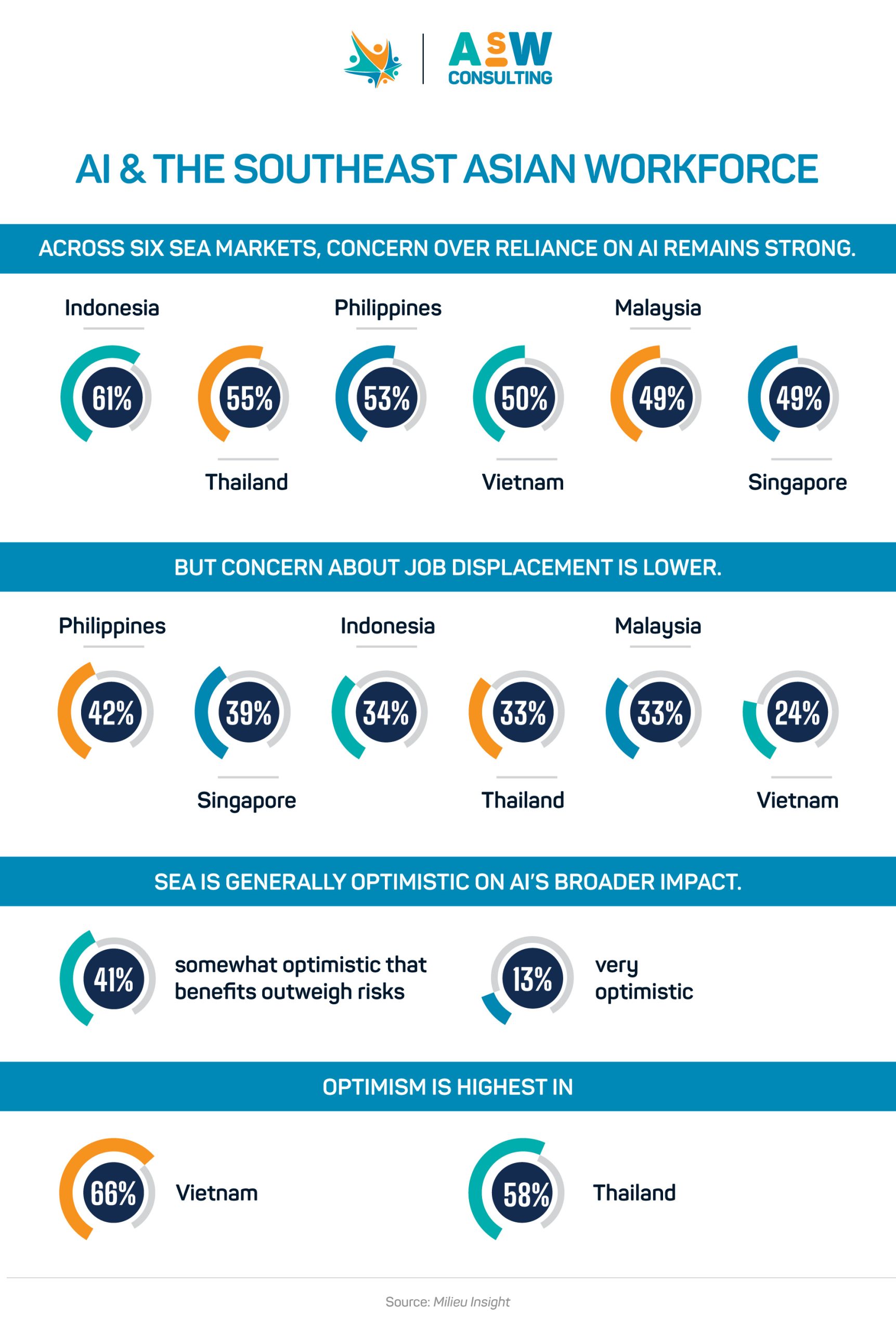
Interestingly, job displacement is not the biggest fear among SEA workers. According to Milieu Insight’s recent study, over-dependence on AI is the top concern (53%) among workers across Southeast Asia, even more than privacy issues (40%) and losing jobs (34%).
Workers are becoming more concerned about how AI could influence decision-making, critical thinking, and independence at work. Instead of viewing AI purely as a job threat, many are worried it may weaken human judgment and core skills.
AI-readiness Trends Across SEA
While each country in the SEA region is moving at its own pace, several consistent themes are emerging. These are just some examples of how SEA countries are preparing and managing the impact of AI.
Singapore: Leading in AI Education and Investment
Singapore continues to position itself as a regional leader in AI readiness. Universities are rolling out AI-focused training programmes for mid-career professionals. The government is investing over S$1 billion in AI research and development by 2030.
✅ Focus: AI literacy, reskilling, and innovation leadership
Indonesia: Workforce Protection Through Upskilling
Indonesia is taking a workforce-first approach to AI. Nationwide upskilling programs aim to prepare workers for AI disruption. A national AI roadmap is being developed to guide long-term adoption.
✅ Focus: job protection, reskilling, and structured AI adoption
Vietnam: Boosting AI Literacy Training
Vietnam is actively preparing its workforce for an AI-driven future through large-scale upskilling initiatives. The government is rolling out free AI training programs for around 2 million young people.
✅Focus: training, upskilling, and global competitiveness
Philippines: Navigating AI Disruption Through Rapid Upskilling
The Philippines is prioritising fast, practical workforce transformation. AI upskilling has been made a national priority with proposed programmes to reskill workers into digital roles. The BPO sector is actively adapting to AI-driven changes, requiring stronger digital skills.
✅Focus: rapid reskilling, BPO transformation, and digital job creation
Thailand: Strengthening AI Strategy and Digital Skills
Thailand is steadily building its AI readiness. A national AI strategy is being developed to improve competitiveness and workforce transformation, with strong focus on digital skills training and AI literacy across key industries.
✅ Focus: strategy alignment and workforce digitalisation

7 Practical Ways to Future-Proof Your Career
For job seekers, the rules of career growth are changing. In the book “Open to Work: How to Get Ahead in the Age of AI” by Aneesh Raman and Ryan Roslansky, the traditional career ladder is being replaced by a more flexible, skills-based journey. Instead of focusing on job titles, professionals must focus on the value they bring and how that value evolves. In short, future-proofing your career is about learning how to adapt and work alongside AI.
1. Build AI and Digital Literacy
AI literacy is no longer a niche skill. It is becoming a baseline requirement across industries in Southeast Asia. Start by exploring tools used in your industry such as generative AI platforms, automation tools, or data-driven dashboards. Employers increasingly value candidates who can “speak the language” of digital transformation.
2. Focus on Skills, Not Job Titles
Instead of defining yourself as “just an accountant,” “marketing executive,” or “HR officer,” think in terms of your transferable skills: data analysis, stakeholder communication, problem-solving, or campaign execution. This mindset is especially important in Southeast Asia, where industries like BPO, retail, and finance are evolving due to AI.
3. Strengthen Human-Centric Skills
While AI is strong in automation and analysis, it still struggles with human depth. Skills such as emotional intelligence, creativity, leadership, negotiation, and storytelling are becoming more valuable. In Southeast Asia’s relationship-driven work culture, these skills are especially powerful.
4. Commit to Continuous Learning
What you learned five years ago may already be outdated in today’s AI-driven workplace. Continuous learning means regularly upgrading your knowledge, whether through online certifications, micro-courses, industry webinars, or even on-the-job experimentation. The most successful professionals in Southeast Asia are those who treat learning as a habit.
5. Learn to Work With AI, Not Against It
One of the biggest mindset shifts job seekers need today is understanding that AI is not a competitor—it is a collaborator. However, your role is to add judgment, context, and decision-making on top of AI outputs. Employers increasingly value professionals who can use AI to multiply productivity rather than resist it.
6. Be Open to Career Transitions
Many professionals today will move across multiple roles, industries, or even entirely new career tracks. Being open to transition does not mean starting over. It means repositioning your existing skills in new ways.
7. Use AI Early and Experiment Often
The fastest way to build confidence in an AI-driven job market is simple: start using AI tools regularly. Experiment with writing assistants for communication tasks, AI tools for research and summarisation, automation tools for repetitive workflows, and productivity apps powered by AI. This makes you more adaptable and more attractive to employers who are actively looking for digitally confident talent.

ASW Consulting: Your Partner in the Future of Work
The future of work is already here. The question is—are you ready for it? If you’re looking to stay competitive in today’s AI-driven job market, now is the time to be proactive. Working with a trusted partner like ASW Consulting—a trusted recruitment agency in Thailand and Vietnam—can help you better understand where your skills fit and how you can position yourself for long-term success.
Our talent acquisition consultants in Thailand and Vietnam work closely with job seekers and employers, bridging the gap between evolving business needs and emerging talent. For professionals aiming for more specialised roles, engaging with a headhunting company in Thailand and Vietnam can open doors to opportunities that are often not publicly advertised.
Contact us today at our recruitment company in Thailand and Vietnam. Let’s work together and explore how we can connect your skills to the right opportunities.
Latest Chamber News

- Industry Focus