Superpresence -Fix your website before you double the ad budget
There are two ways to get more leads: buy more visitors or convert more of the ones you already have. Most budget meetings only discuss the first.
Deciding in that order costs money. As the foundation for marketing, your website controls two numbers at once: how many visitors send an inquiry, and how much Google charges you per click.
If the page can’t convert the traffic it gets now, a bigger budget just buys more visitors who leave without enquiring. Fix the page first, then pay to send more visitors to it.
Your site decides your cost per lead
Start with the conversion rate. Leave your ad spend and your click volume exactly where they are, and change only the share of visitors who enquire. What each inquiry costs you changes immediately, even though the ads haven’t changed.
Say you spend $5,000 and it buys 1,000 clicks. If 1% of those visitors enquire, you get 10 enquiries at about $500 each. If 3% enquire, you get 30 enquiries at about $167 each. Same spend, same traffic, the only thing that changed was the page.
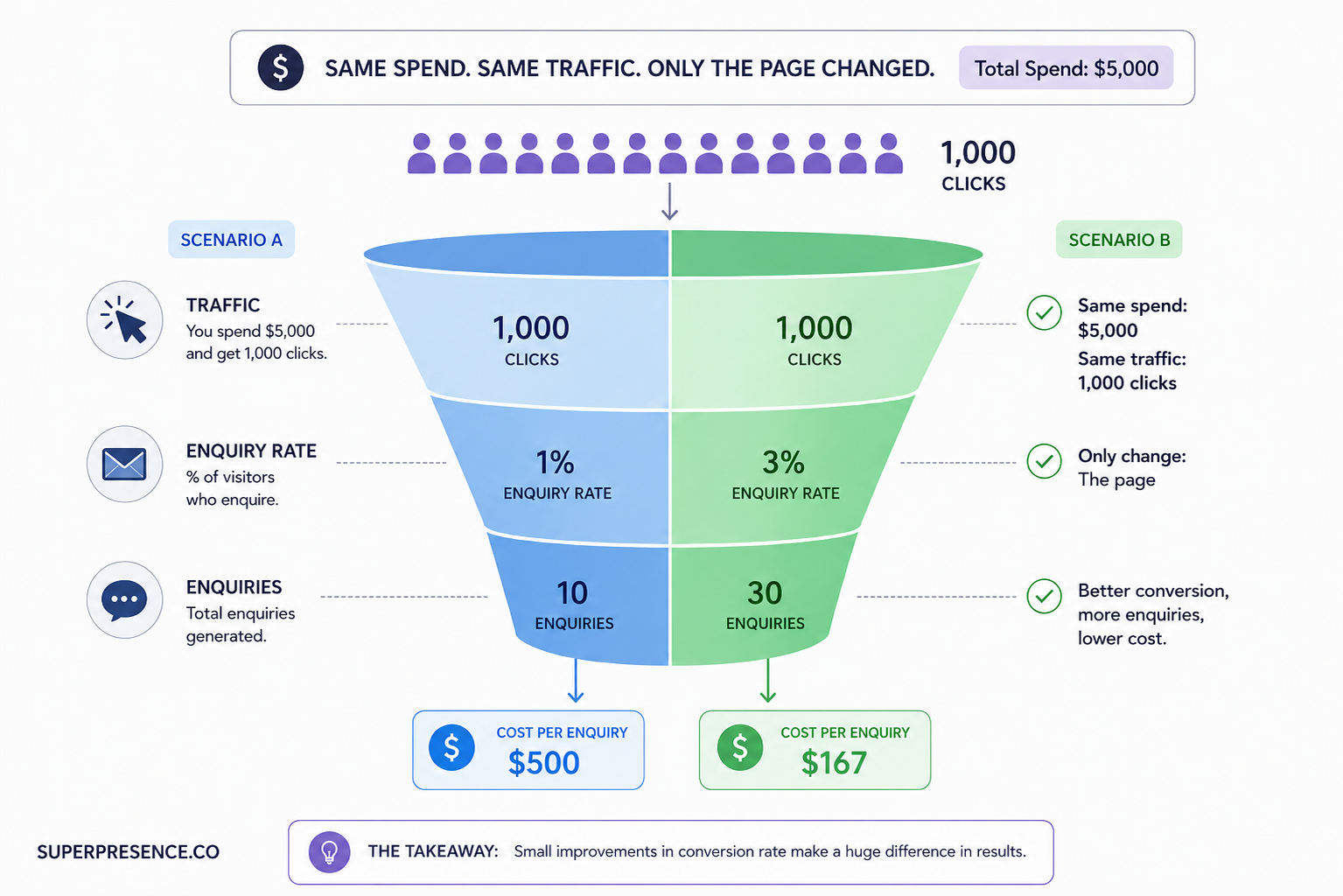
Most websites sit closer to that 1% than to the 3%. The median site selling to other businesses turns about 2.4% of visitors into leads. Weaker sites manage nearer 0.8%, while the best quarter clear 5% or more.
The second number your website controls is the price of the click. Landing page experience makes up about a third of Google's Quality Score. A page Google rates below average can cost 30 to 70% more per click than one it rates above average.
So both numbers come from the same pages. When you brief a web design agency, give them a conversion target along with the build dates.
Is it the ads or the landing page?
Before you raise the budget, run one check: pull your click-through rate against your conversion rate. Together they show you whether the problem is the ads or the page.
When an ad is doing its job, people click. If those visitors land on the page and still don't enquire, the page is where they're dropping off. A strong click-through rate next to a flat conversion rate is the clearest sign of that.
The opposite case looks different. If the click-through rate itself is weak, the problem never reaches the page at all.
The keywords are off, the placements are off, or the audience was never in the market to begin with. That one sits on the traffic side, and it's the cheaper problem to fix.
Most businesses skip that comparison. They see flat enquiries, assume it's an audience problem, and go looking for new keywords or a new agency without changing the page.
Fix these four things before you scale
Four changes matter more than the rest, and none of them need a rebuild.
- Send paid clicks to a dedicated page. Your ad promises one thing and your homepage tries to answer ten. Pages built for a single offer score 2 to 4 times better on landing page experience. Building that page, with the layout and words matched to the ad, is what web design services are for.
- Put your proof next to the inquiry form. Case studies, named clients, real bios, and a plain account of how you work. Someone about to spend real money wants proof they can check first.
- Fix your speed and your mobile pages. Both feed into how Google scores the page, so a slow page on a phone costs you the inquiry and the Quality Score together.
- Make the next step obvious. One clear action per page. If a visitor has to work out what to do, most will do nothing.
How do you know the site is ready?
Decide your minimum conversion rate before you decide the budget. For a high-value service, about 2% of visitors becoming enquiries is the lowest rate worth spending against. Above 3 to 5%, extra ad spend brings in more enquiries for the same money.
Under the 2.4% median, the page is losing most of the visitors you paid for. Treat those numbers as a rough range, since results vary by industry. Once your conversion rate is above 2%, raise the budget in steps instead of doubling it.
Watch what each inquiry costs as you spend more, because your ad views will rise either way. If the cost per inquiry stays flat as the spend goes up, the page is converting the new traffic as well as the old.
Fix the page, then raise the budget
Approving a bigger budget is easy, because it is one number in one meeting. Fixing the website takes longer, and it sets the return on every dollar you spend afterwards.
So fix the page first, then pay to send more visitors to it. Your conversion rate is already in your analytics, and it tells you which of those two results you get.
That's the part Superpresence works on. We're a B2B web design agency working with companies across Asia, and the page is always where we start. Get a free site review, or get in touch at kelvin@superpresence.co.
Latest Chamber News

- Industry Focus